
Low Dye Taping for Runners: A Simple Foot Support Technique Every Runner Should Know

Jessica McDonald – MOVE Sports Physiotherapy & Pilates Geelong
Foot pain is one of the most common issues we see in runners; from plantar fasciitis and arch strain to shin pain, posterior tibialis tendiopathy and general “sloppiness” through the foot and ankle.
When your foot isn’t absorbing load well, the rest of your kinetic chain has to work harder.
Low Dye taping is one of the quickest, simplest and most effective taping techniques for runners who need short-term support. In fact, it’s probably one of my most-used taping methods in the clinic and on the sidelines.
There are countless ways to do it, and physios often develop their own variations. But the method below is the easiest and most reliable starting point.
If you love the feel of the support and want to learn more advanced versions, we cover these in depth inside our online Taping course.
What Is Low Dye Taping?
Low Dye taping is a rigid taping technique designed to:
Support the medial arch
Reduce excessive pronation
Offload the plantar fascia
Improve foot stability
Reduce stress on the ankle, shin, knee and even hips
For runners, this can mean:
Less morning pain
Less pulling under the arch
Better control during longer distances
Reduced strain during hills, speed work or fatigued form
A lighter, more supported feel through stance phase
Low Dye doesn’t “fix” the underlying causes of foot pain, but will give you immediate mechanical support while we work on the underlying strength and load issues.
Why Runners Love Low Dye Taping
Whether you're training for your first 5 km or preparing for a marathon, Low Dye taping can be a valuable tool for managing symptoms and supporting performance. By providing additional arch support, it can help reduce strain on the plantar fascia during running, often easing irritation and discomfort. It is also commonly used to assist runners experiencing tibialis posterior overload, including medial shin pain and tibialis posterior tendinopathy, by improving foot mechanics and reducing stress on the affected tissues.
Many runners describe the sensation as feeling like their foot is “held together better,” particularly when running on harder surfaces or covering longer distances.
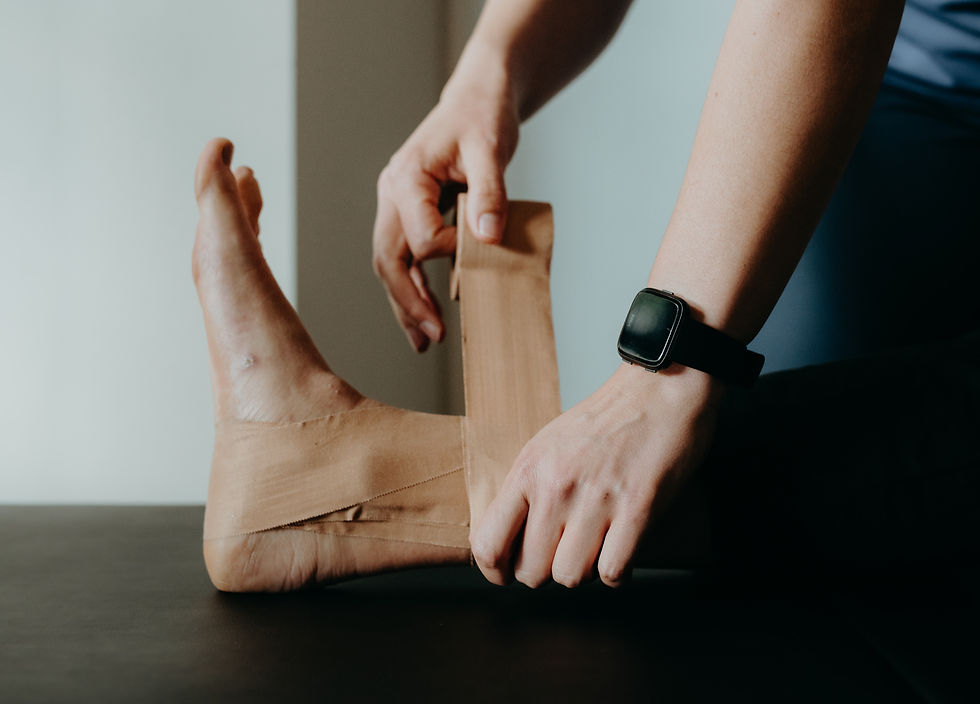
Step-by-Step Low Dye Taping for Runners
A simplified version based on the taping method used at MOVE Sports Physio Geelong
Step 1: Prepare the Foot
Clean and dry the skin
Trim excess hair if needed
Use Fixomull if the skin is sensitive
Have the runner in a relaxed standing or long-sitting position with the foot at 90 degrees.
Step 2: Create the Anchor
Apply a strip:
From the base of the big toe
Around the heel
To the base of the little toe
This becomes your foundation.
Step 3: Add the Arch Support Strips
Apply vertical/fan-shaped strips from the heel towards the inside (medial) arch.
Overlap each strip by about 50%.
These strips lift and support the medial longitudinal arch.
Step 4: Add Horizontal Strips for Stability
Place horizontal strips across the mid-foot to lock the arch support in place.
This is the part runners often feel instantly supported
Step 5: Finish With a Locking Strip
Add a final strip around the foot to secure all the pieces without excessive tension.
The tape should:
Feel secure
Not cause numbness or tingling
Allow running with confidence
Check that the runner can walk comfortably before heading out for a run.
How Long Does Low Dye Taping Last?
For most runners:
It lasts 1–3 days depending on sweat, surface, and tape quality
It can be worn during training or racing
Remove immediately if the skin feels hot, itchy or irritated
Low Dye taping is a perfect short-term strategy — but not a standalone fix.
When Low Dye Taping Isn't Enough
Low Dye taping can be a great short-term tool, but if you find yourself relying on it for every long run, speed session, race day, or even a short jog, your body may be telling you something.
Often, the solution lies in addressing the underlying cause through targeted strength work, running technique assessment, footwear review, load management, or, in some cases, orthotic intervention.
Rather than simply managing symptoms, a sports physiotherapist can help identify the root cause and develop a plan to keep you running with confidence.

Get pain relief and improved foot control at MOVE!
At MOVE Sports Physiotherapy & Pilates Geelong, we work with runners at every level
— from local park-runners to marathoners. We offer;
Running assessments
Running assessment/program packages
Foot and ankle strength programs
Plantar fascia and shin pain rehab
Return-to-running plans
Taping tutorials and on-field support


