Clinical Pilates & Strength
- Tanner Nyholm

- Feb 17
- 3 min read
Why we blend both at MOVE Sports Physio Geelong
Tanner Nyholm - Physiotherapist
Clinical Pilates is often viewed as a low-load form of exercise. While this perception isn’t entirely wrong, it dramatically underestimates the strength, control, and physical capacity that well-designed, physiotherapy-led Pilates can develop.
One of the key reasons clinical Pilates is overlooked from a strength perspective is variability in intensity. Unlike traditional gym-based training where load is obvious (kilograms on a barbell), Pilates uses springs, leverage, time under tension and body position to manipulate resistance. Without clear measures, strength gains can be harder to see even when they’re happening.
That’s why measuring strength is critical.

Why Measure Strength in Clinical Pilates?
Physiotherapy-led Pilates isn’t just about movement quality, it’s about measurable outcomes. Strength assessment allows us to:
Support Functional Strength for Everyday Life
Strength underpins almost every daily task:
Getting up from a chair
Carrying groceries
Climbing stairs
Picking up children
Maintaining balance and posture
Clinical Pilates targets these movements in controlled, repeatable ways. Measuring strength ensures that improvements in the studio translate to real-world function.
Track Progress When You Feel Stagnant
Many clients say, “I feel better, but I don’t know if I’m getting stronger.”Objective measures help show progress when subjective feelings plateau. Seeing numbers improve, builds confidence, motivation, and trust in the process.
3. Compare Your First Session to Where You Are Now
Baseline testing allows:
Clear comparison from your first session to reviews
Evidence-based progression
Smarter goal setting
Strength gains don’t always feel dramatic, but data doesn’t lie.
Common Strength Outcome Measures Used in Clinical Pilates
Physiotherapists use simple, validated tests that relate directly to Pilates performance.
These measures give us a snapshot of how well your body produces, controls, and sustains force.
30-Second Sit-to-Stand Test
Measures lower limb strength and endurance
Directly relevant to reformer squats, footwork, and daily tasks
Maximum Push-Ups
Assesses upper body strength and trunk control
Relates to long box work, planks, and arm-supported exercise
Maximum Plank Hold
Measures core endurance and shoulder stability
Strong predictor of Pilates performance and injury resilience
Modified CTSIB / Single-Leg Balance
Assesses balance, proprioception, and motor control
Essential for unilateral reformer work and dynamic stability
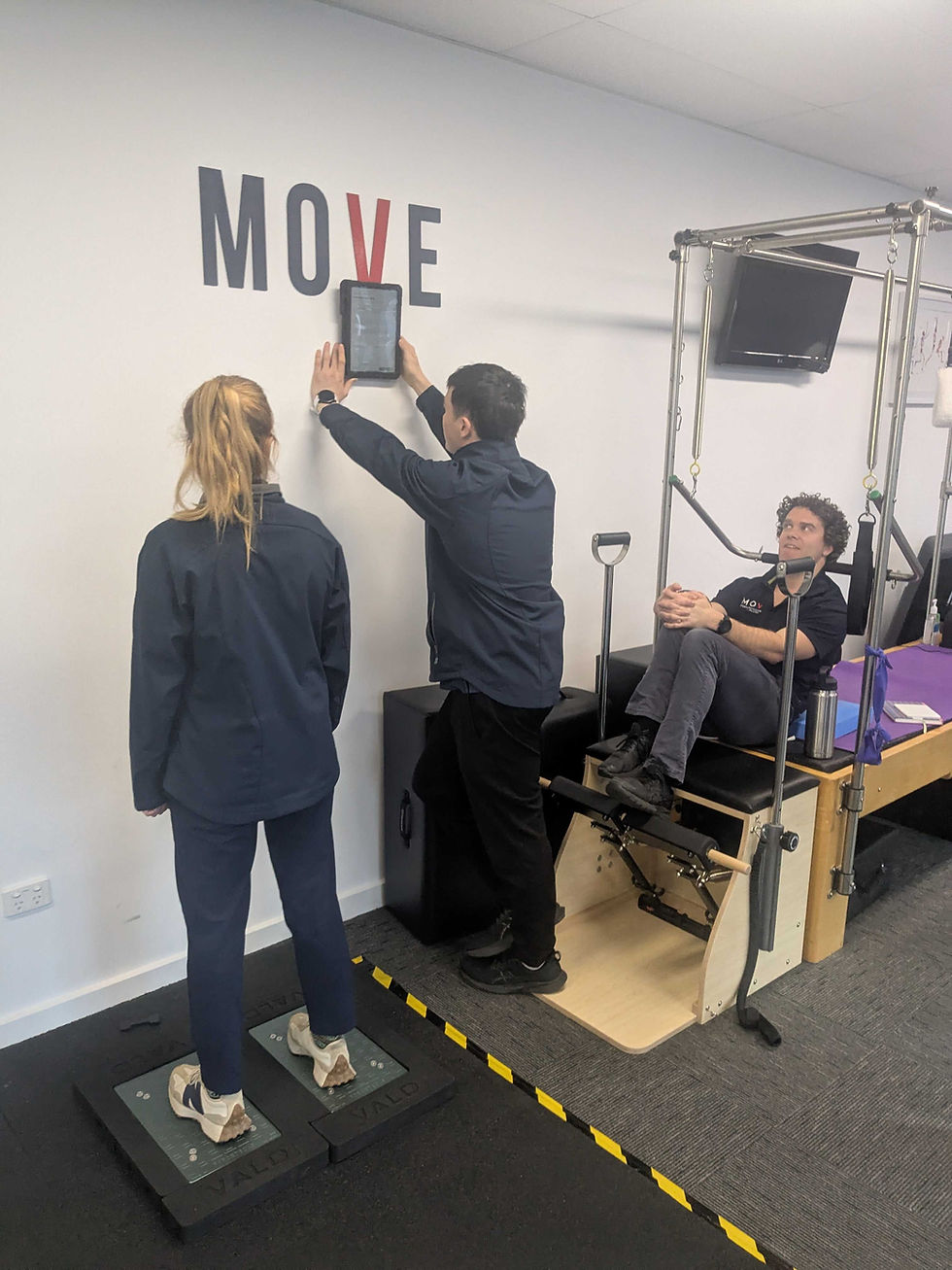
VALD testing
Strength Measurement Within Pilates Sessions
Strength can also be assessed dynamically during class or 1:1 sessions. These subtle changes are powerful indicators of real strength gains.
Exercise Completion: Can you complete a previously challenging exercise (e.g. pulsing scooter) with better control and less fatigue?
Spring Resistance: Progressing to heavier springs or maintaining form on lighter springs with increased complexity.
Time Under Tension: Longer sets, slower tempos, or sustained holds indicate improved muscular endurance
Fatigue Management: Improved consistency across repetitions and less need to reduce springs mid-set
Reduced External Feedback: Less reliance on tactile or verbal cues, and improved intrinsic body awareness and control

Integrating VALD Force Plates & Objective Strength Data
In more advanced settings, force plates can provide additional insight, replicating movements similar to reformer work, such as:
Squats
Leg press patterns
Jumping and landing mechanics
Squat & Countermovement Jump (CMJ) Analysis
Measures force output, symmetry, and rate of force development
Strong relationship between reformer leg press strength and jump board performance
This is particularly valuable for:
Athletes transitioning back to sport
Clients progressing from rehab to performance
Objective return-to-impact decision-making
Clinical Pilates as a Gateway to Strength & Conditioning
One of the greatest strengths of clinical Pilates is its role as a foundation for more progressive training.
A Safe Introduction to Exercise
Ideal for pain, injury, or de-conditioned clients
Controlled, low-threat environment
Mastery of Movement Fundamentals
Breathing
Spinal control
Hip and shoulder mechanics
Progressive Load Without Overwhelm
Resistance can be increased subtly
Builds confidence before entering gym-based programs
Deep Core Engagement: More Than Just “Activation”
Clinical Pilates excels at training the deep core system:
Transversus abdominis
Pelvic floor
Diaphragm
Multifidus
Rather than isolated “activation,” Pilates integrates these muscles into functional, loaded movement, such as; improved force transfer, stability underload and reduced injury risk.
This forms the foundation for stronger, more resilient movement — both inside and outside the studio.
Clinical Pilates is not just mobility or rehab — it is measurable strength training when delivered with intent, structure, and objective assessment.
By tracking strength through outcome measures, in-session performance, and advanced tools like force plates, physiotherapy-led Pilates becomes:
Evidence-based
Goal-driven
Performance-focused
Strength deserves to be seen — and measured.
Clinical Pilates is not just mobility or rehab
It is measurable strength training when delivered with intent, structure, and objective assessment.
Leading to evidence based and performance focused training for all stages of life.
Ready to start your Clinical Pilates Journey?
Book an Initial Assessment at MOVE Sports Physiotherapy & Pilates Geelong